Pilates
Pilates at CrossFit Full Armor
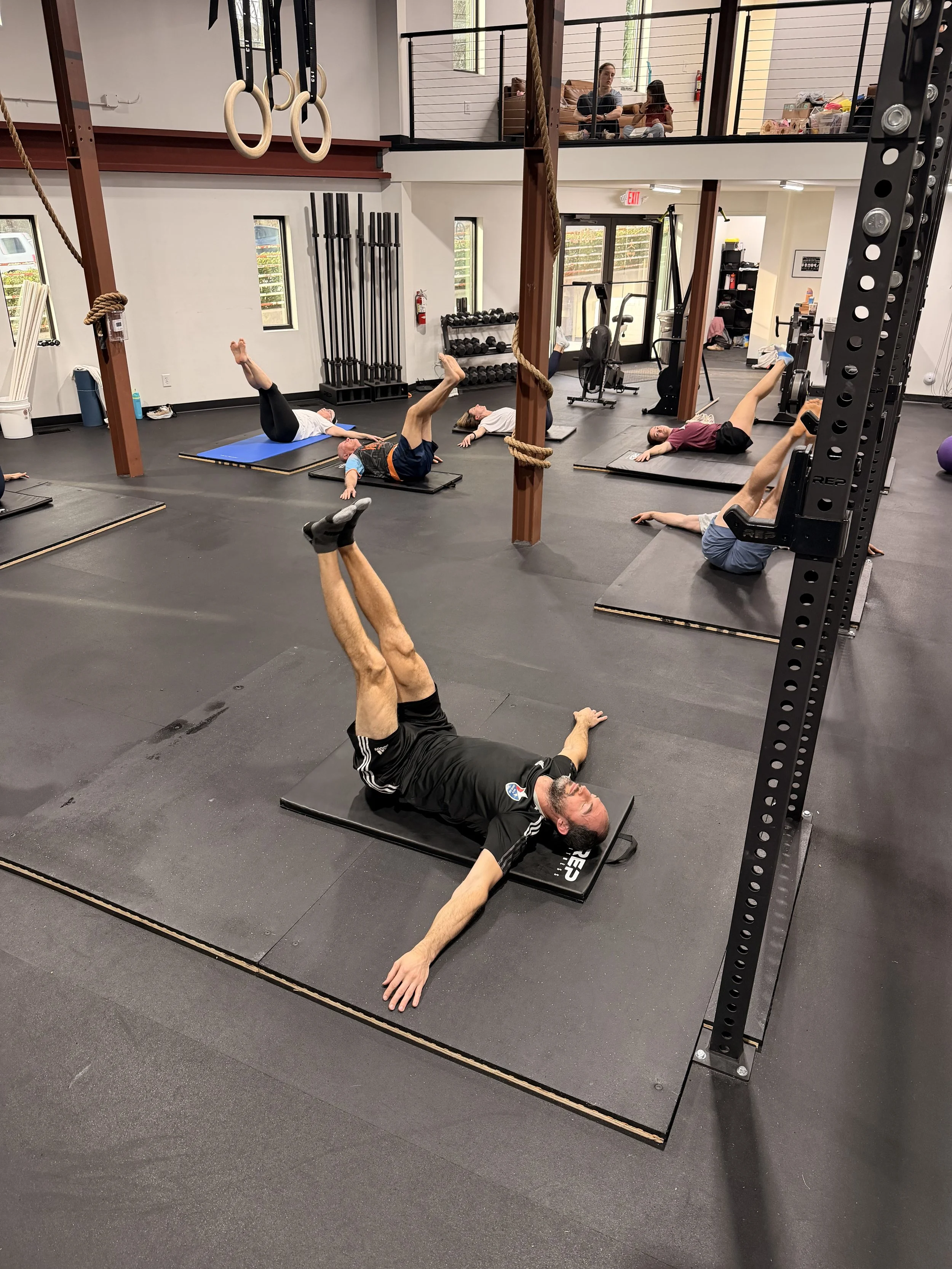
Build core strength, improve flexibility, and move with control. Our Pilates classes are designed for all levels—whether you're recovering from injury, complementing your CrossFit training, or looking for a low-impact workout that challenges your entire body.
Why Pilates Makes You Better at CrossFit (And Everything Else)
If you've ever struggled with pull-ups, felt unstable in the bottom of a squat, or experienced lower back pain during deadlifts, the problem might not be strength—it might be core stability, mobility, and body control.
That's where Pilates comes in.
Pilates doesn't replace your strength training or metcons. It enhances them by building the foundational stability, mobility, and movement patterns that make every other movement better.
Here's how Pilates directly improves the movements you do every day at CrossFit Full Armor:
-
The problem:
Your lats and arms might be strong enough to pull, but if your core isn't stable, you'll arch your back, swing uncontrollably, or lose tension at the top of the movement.How Pilates helps:
Hollow body holds and rolling patterns teach you to maintain a tight, braced midline while moving
Shoulder stabilization work (arm circles, push-up variations) strengthens the small stabilizer muscles that keep your shoulders safe and efficient during pulling
Controlled breathing under tension trains you to stay tight even when fatigued
Result: Smoother kipping, stronger hollow position, fewer shoulder issues, more efficient pull-ups and muscle-ups.
-
The problem:
Limited shoulder mobility or weak stabilizers force you into bad positions—forward shoulders, hyperextended lower back, or poor overhead lockout.How Pilates helps:
Thoracic spine mobility work (spine stretch, saw, threading the needle) opens up your upper back so you can get into a proper overhead position without compensating
Shoulder stabilization exercises (planks with arm reaches, side planks, push-up variations) strengthen the rotator cuff and scapular muscles that keep your shoulders stable under load
Core control prevents your lower back from overextending when you go overhead
Result: Better overhead positions, stronger lockout, fewer shoulder tweaks, cleaner snatches and jerks.
-
The problem:
Tight hips, stiff ankles, or weak glutes cause you to lose depth, collapse your knees inward, or round your lower back at the bottom of a squat.How Pilates helps:
Hip-opening movements (leg circles, bridges, clamshells, side-lying series) improve hip flexor flexibility and glute activation
Ankle mobility drills and controlled foot/toe work increase ankle dorsiflexion (the ability to get your knees over your toes)
Deep core engagement (transverse abdominis work) teaches you to brace properly without holding your breath
Result: Deeper squats, better knee tracking, stronger bottom position, less lower back compensation.
-
The problem:
Poor running posture (rounded shoulders, weak hips, shallow breathing) leads to inefficiency, slower times, and increased injury risk.How Pilates helps:
Postural awareness and alignment work teaches you to run tall with an engaged core instead of slouching forward
Hip strengthening (single-leg bridges, leg lifts, side-lying work) builds the glute medius and hip stabilizers that prevent knee valgus (knees caving in) and IT band issues
Breathwork and rib cage expansion improves your ability to breathe deeply and efficiently while running
Result: Better running posture, stronger hips, more efficient breathing, fewer running-related injuries.
-
The problem:
Weak core endurance or poor hip hinge mechanics cause your lower back to round, your hips to shoot up first, or your power to leak out during long rowing efforts.How Pilates helps:
Spinal articulation exercises (roll-ups, roll-downs, cat-cow) teach you to move through your spine with control and maintain a neutral position under fatigue
Hip hinge patterns (bridges, single-leg work, hamstring stretches) reinforce proper posterior chain engagement
Core endurance drills (the hundred, planks, side planks) build the stamina to hold good positions for 500m, 1000m, or longer rows
Result: Better rowing mechanics, stronger core endurance, more power transfer, less lower back pain.
-
The problem:
If you can't brace your core properly or control your spinal position, you'll round your back, lose tension, or miss lifts you should be able to hit.How Pilates helps:
Deep core activation (transverse abdominis, pelvic floor, diaphragm) teaches you to create true intra-abdominal pressure, not just "suck in your gut"
Spinal stabilization exercises (bird dogs, dead bugs, planks) train your body to resist unwanted movement (anti-extension, anti-rotation)
Breath control ensures you're bracing with your breath, not holding it inefficiently
Result: Better bracing, stronger spinal stability, safer lifting, more weight moved.
-
The problem:
Handstand walks and gymnastics movements require extreme body control—if your core is weak or your shoulders aren't stable, you'll wobble, arch, or fall.How Pilates helps:
Balance and proprioception drills (single-leg work, unstable positions) improve your body's ability to find and hold positions
Hollow body and arch holds teach you to control spinal position even when inverted
Shoulder stabilization strengthens the muscles that keep you upright and controlled in a handstand
Result: Steadier handstands, smoother walks, better control in gymnastics movements.
-
The problem:
Loaded carries expose weak links—if your core can't resist rotation or your posture collapses under load, you'll lean, twist, or lose the weight.How Pilates helps:
Anti-rotation exercises (side planks, oblique work, Pallof press-style movements) train your core to resist twisting under uneven loads
Postural endurance (long holds, breathing under tension) builds the stamina to stay upright and braced for 100m, 200m, or longer carries
Shoulder and scapular stability keeps your shoulders packed and safe under heavy loads
Result: Straighter carries, less twisting, stronger posture, better grip endurance.
The Bottom Line
Pilates doesn't replace CrossFit. It makes CrossFit better.
Every movement you do—pull-ups, snatches, squats, running, rowing, muscle-ups, carries—requires:
Core stability (to transfer power and protect your spine)
Mobility (to get into proper positions)
Body control (to move efficiently and avoid injury)
Pilates builds all three.
It's not about doing Pilates instead of CrossFit. It's about doing Pilates to improve your CrossFit.
Stronger core. Better positions. Fewer injuries. Better performance.

What Is Pilates?
Pilates is a low-impact, full-body workout that focuses on core strength, flexibility, balance, and controlled movement. Unlike high-intensity training, Pilates emphasizes precision, breath, and alignment—making it perfect for injury recovery, mobility work, or a mindful movement practice.
Benefits of Pilates:
Builds core strength and stability
Improves flexibility and posture
Reduces back pain and joint stress
Enhances body awareness and control
Complements high-intensity training (perfect for CrossFit athletes)
The History of Pilates
Pilates was created by Joseph Pilates (1883–1967), a German physical trainer who developed the method in the early 20th century. As a sickly child suffering from asthma and rickets, Joseph dedicated himself to overcoming his physical weaknesses through studying anatomy, gymnastics, yoga, and martial arts—transforming himself into a strong, healthy athlete.
During World War I, while interned in England, Joseph began developing his exercise system to help fellow internees maintain their health. He rigged springs to hospital beds so bedridden patients could exercise while lying down—the foundation for what would become the Pilates reformer machine. When a deadly influenza epidemic swept through England in 1918, none of the internees under his training program died, demonstrating the power of his method.
Joseph called his system "Contrology"—the art of controlled movement. In 1926, he moved to New York City and opened a studio that quickly became popular with dancers. Legends like George Balanchine and Martha Graham sent their students to train with him because Pilates built core strength, improved flexibility, and helped prevent injuries without adding bulk.
The Six Core Principles of Pilates:
Concentration — Full mental focus on each movement
Control — Precise, deliberate movements
Center — All movement originates from the core (the "powerhouse")
Flow — Smooth, continuous movement
Precision — Quality over quantity
Breathing — Controlled breath patterns to fuel movement
Joseph Pilates continued teaching until his death in 1967 at age 83. His students spread the method worldwide, and today Pilates is practiced by athletes, physical therapists, and fitness enthusiasts as a proven system for building strength, mobility, and resilience.
At CrossFit Full Armor, we offer mat-based Pilates—the original foundation of Joseph's method, requiring no equipment and accessible to all levels. Perfect for building core strength, improving mobility, and complementing your CrossFit training.
Schedule
Message us if there is a day/time you would like to see on the calendar.
Wednesday: 6:30pm
Thursday: 5:30pm (coming soon)
Format: Mat-based Pilates (no reformer required)
Pricing
Drop-In: $25/class
10-Class Pack: $150 ($15/class)
Unlimited Monthly: $80/month (auto/renews, cancel anytime)
Full Armor Members: Add unlimited Pilates for $40/month (auto/renews, cancel anytime)
Free Trial: Try out a class before signing up
*Click button below to purchase packages and sign into class
Who Should Take Pilates
-
looking to improve mobility, core strength, and recovery
-
Low-impact introduction to fitness
-
Post-surgery, chronic pain, joint issues
-
Seeking safe, effective movement
-
Wanting to build a strong, flexible, pain-free body
Who This Is For FAQ
-
No! Classes are designed for all levels. Modifications are provided for beginners.
-
Just a mat and water. We have mats available if you don't have one.
-
Pilates is great for injury recovery, but check with your doctor first. Let the instructor know about any limitations.
-
Pilates focuses on core strength, controlled movement, and stability.
-
Absolutely. Pilates improves core stability, mobility, and body awareness—all of which translate to better performance in CrossFit.
Ready to Try Pilates?
Drop in for your first class or sign up for a package today.